What’s happening?
New NRMA Insurance data shows wild weather is putting growing pressure on households across Australia, including in Queensland.
The insurer’s latest Wild Weather Tracker, released on 24 March 2026, shows storms, hail, floods, cyclones and lightning have continued to damage homes and vehicles over the past five years.
NRMA Insurance said the impact is no longer limited to one season. Wild weather is now affecting Australians across much of the year, with summer and autumn driving most claims.
The report also shows that concern is rising. More Australians say they are worried about weather damage than they were five years ago, and more are changing how they prepare for it.
NRMA Insurance Meteorologist Peter Chan said Australia faces a wide range of hazards.
“In Australia, we are exposed to just about every possible hazard, from fires and floods to severe thunderstorms and tropical cyclones.
“In a warming climate, extreme weather events are expected to become more frequent and intense for many regions in Australia.”
He said conditions could stay volatile through autumn.
“Warm, dry conditions and elevated bushfire risk are likely to persist across parts of southern Australia including New South Wales, Victoria and South Australia. While northern regions of Queensland, the Northern Territory and Western Australia may stay wetter than usual with a higher chance of tropical systems and severe storms.”
Why it matters?
This matters because severe weather is affecting more homes, more vehicles and more daily decisions.
The report shows more people are now thinking about weather risk when buying property. It also shows more households are putting emergency plans in place and taking practical steps before storms hit.
NRMA Insurance Executive Manager Claims Scott Lindsay said the data shows both pressure and progress.
“More Australians are living with wild weather as part of their day-to-day lives, and we’re seeing a growing commitment to getting prepared,” Mr Lindsay said.
“Severe weather can strike suddenly, but small steps to prepare ahead of time make a big difference. This season we recommend clearing your gutters, trimming overhanging branches and checking the condition of your roof to help reduce your home’s vulnerability.”
Local impact
Redlands was one of Queensland’s hardest-hit areas for wild weather claims over the past five years, according to NRMA Insurance data.
Capalaba ranked as the second most impacted suburb in Queensland with 434 claims, while Redland Bay recorded 293 claims and Alexandra Hills logged 282 claims. That puts three Redlands suburbs in the state’s top 10 for wild weather claims.
The figures show how exposed parts of Redland City have been to repeated severe weather, especially as storms and hail remained the biggest drivers of damage across Queensland.
Beyond Redlands, other high-claim areas included the Gold Coast, Logan – Beaudesert, Brisbane – East and the Sunshine Coast, showing the broader pressure across South East Queensland.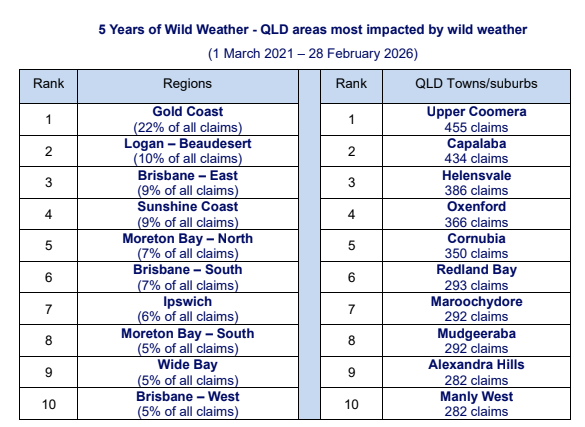
By the numbers
- Queensland recorded 40,300 wild weather claims between 1 March 2021 and 28 February 2026, made up of 31,534 home claims and 8,766 motor claims.
- Wild weather caused 59% of all Queensland home claims, showing how heavily severe conditions are shaping insurance activity across the state.
- Storms made up 49% of Queensland wild weather claims, followed by hail at 23%, cyclone at 14%, floods at 7% and lightning at 3%.
- Summer accounted for 38% of Queensland wild weather claims, while autumn made up 30%, spring 29% and winter 3%.
- Spring 2025 was Queensland’s hardest-hit season, with 7,483 claims lodged.
- In summer 2025-26, Queensland recorded 514 wild weather claims, including 438 home claims and 76 motor claims.
- 38% of Queenslanders said severe weather damaged their property or vehicle in the past five years.
- 69% of Queenslanders said they are worried that natural disasters are becoming more frequent and severe.
- 46% now have an emergency plan in place, up from 37 % five years ago.
Zoom in
The report shows Queenslanders are not just feeling the impact, they are changing their behaviour because of it.
More residents say wild weather now affects daily life, and more say they are likely to prepare for future events after what they have seen in recent years.
That shift is also showing up nationally. NRMA Insurance found more people now consider wild weather risk when looking at a property to buy, and more households have emergency plans than they did five years ago.
The tracker is now in its fifth year, and this edition draws on claims lodged between 1 March 2021 and 28 February 2026. The consumer research was conducted by Pureprofile for NRMA Insurance across February and March 2026 among 3,012 Australians.
Zoom out
Across Australia, NRMA Insurance received nearly 300,000 wild weather claims over five years, or around one every nine minutes.
The report said wild weather made up 57% of all home claims, while 31% of Australians reported damage to their property or vehicle in that period.
It also found 46% of Australians are now more concerned about weather damage to their home than they were five years ago.
The biggest event during the period was the 2022 Northern NSW and South East Queensland floods, which generated the highest number of claims.
About NRMA Insurance
NRMA Insurance said it helps more than 3 million Australians protect what matters. Founded in 1925, it began as a member-only company providing motor insurance to the first drivers in New South Wales. The insurer said it continues to work with communities through its Help Nation initiative to help Australians understand local risks and prepare for extreme weather.
What to look for next?
Households may keep taking practical steps as severe weather risks stay high in parts of Australia.
NRMA Insurance is urging people to prepare early by clearing gutters, trimming overhanging branches and checking their roof.
The data also points to growing community awareness, with more people putting emergency plans in place and thinking about weather risk before the next major event.