What’s happening?
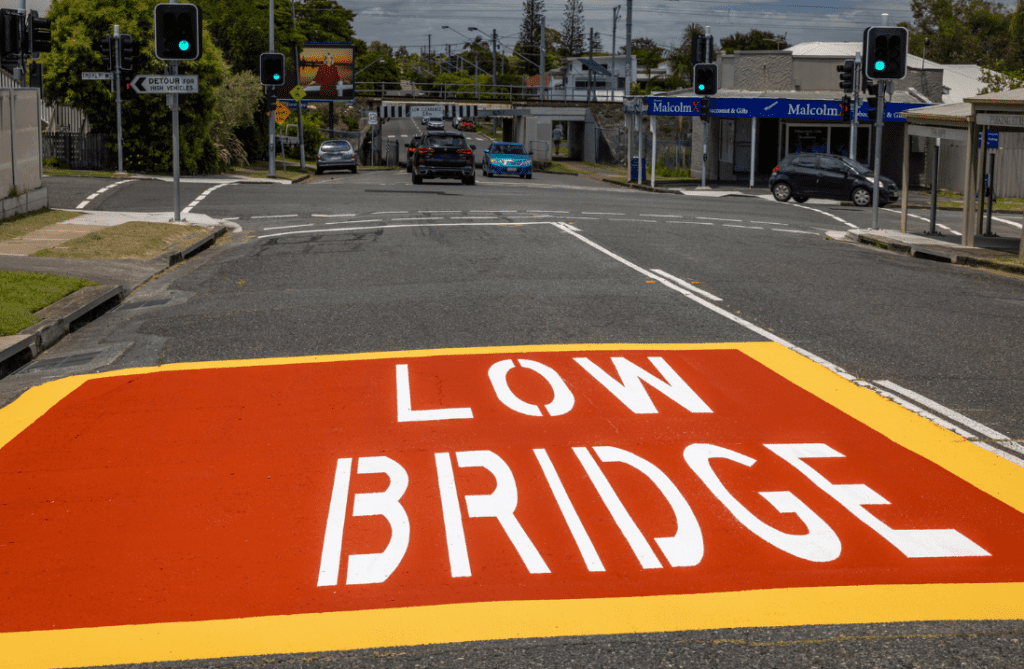
Bright red and yellow road markings have been painted on the approach to the Pine Street rail bridge in Wynnum.
The markings form boxed warnings on the bitumen and clearly state “low bridge”.
The trial is being delivered by Queensland Rail in partnership with the Department of Transport and Main Roads and Brisbane City Council.
The trial coincides with the release of new footage showing over-height vehicles crashing into rail bridges and protection beams.
The footage shows debris flying, machinery destroyed, and one truck bed being torn in two.
Why it matters
Rail bridge and protection beam strikes are dangerous and highly disruptive. Each incident places drivers, rail customers, and other road users at risk.
Strikes can also damage critical infrastructure and cause major delays across the rail network.
Queensland Rail Executive General Manager of SEQ Assets Dave Smale said, “Every rail bridge or protection beam strike puts lives at risk and causes major disruption for rail customers and impacts to road users.”
Local impact
Pine Street, Wynnum, is one of the most frequently struck rail bridges in South East Queensland. Incidents at the bridge regularly cause traffic disruption and rail delays in the local area.
Wynnum Manly Ward Councillor Alex Givney said, “We’ve seen several incidents recently with drivers underestimating their vehicle’s height against the bridge, resulting in dangerous accidents and frustrating delays.”
He said the trial showed strong cooperation between agencies. “We know the community has shared their concerns and it’s great to see Queensland Rail, the State Government and the Brisbane City Council working together to make our streets safer,” Cr Givney said.
By the numbers
Pine Street, Wynnum, was struck 22 times by over-height vehicles between January and November 2025, placing it among the most hit bridges in SEQ.
Across the SEQ rail network, rail bridges and protection beams were struck 348 times from January to the end of November 2025.
In 2025 alone, there were 77 rail bridges and 271 protection beams hit by over-height vehicles across the region.
Zoom in
The painted road markings are designed to act as an early warning.
They encourage drivers to slow down and double-check vehicle height before reaching the bridge.
The markings are similar in style to school-zone warnings and sit alongside existing signage and height indicators.
Mr Smale said, “The painted road markings are designed to grab drivers’ attention before it’s too late.”
“This initiative is in addition to clearly visible advance warning road signs, height signage, monitoring cameras, and, in some cases, protection beams,” he said.
Zoom out
Bridge strikes remain a growing safety and reliability issue across South East Queensland.
Queensland Rail continues targeted safety campaigns, including Don’t get your truck stuck! and Know your load, before hitting the road!
The organisation also works with Queensland Police Service and the National Heavy Vehicle Regulator on high-visibility operations at known strike locations.
“Bridge strikes not only delay rail customers but are potentially very dangerous to the driver and other road users, as well as impacting road traffic,” Mr Smale said.
What to look for next?
The Pine Street trial will be monitored over the next two years. If the markings prove effective, the approach could be rolled out to other high-risk rail bridges.
Drivers who damage rail infrastructure face fines of $1,335 and four demerit points, with court penalties of up to $13,352.
Rail bridge strikes should be reported immediately to Queensland Rail using the phone number on the bridge identification plate or by calling 1800 079 303.