What’s happening?
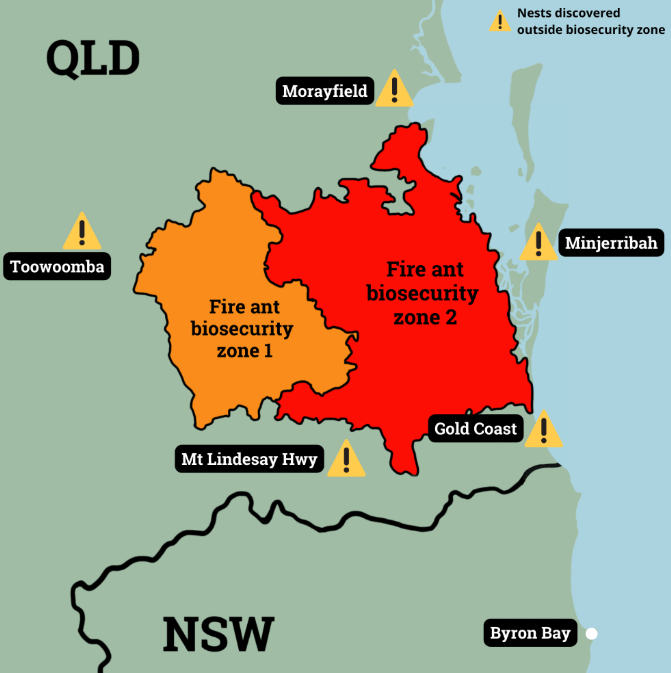
With Christmas and school holidays just around the corner, families and holidaymakers across northern NSW and south east Queensland are being urged to take action against one of Australia’s most destructive pests.
The Invasive Species Council is calling on local communities to join the fight against fire ants by looking, snapping, and reporting any suspected sightings while enjoying time outdoors this summer.
By taking part, families can engage in a simple citizen science activity while helping protect their community from the dangers of fire ants.
Why it matters
Fire ants pose serious risks to human health, agriculture, wildlife, and infrastructure. Community reporting remains the main way fire ants are detected, particularly during warmer weather and following flooding events.
Invasive Species Council Advocacy Director Reece Pianta said the threat extends to popular holiday destinations.
“Whether you’re a local or a visitor, we all enjoy being outdoors in these beautiful places over the summer holidays. Sadly these incredible holiday spots are at risk of a fire ant invasion, so we’re asking Australian families to step up and join the fire ant fight,” he said.
Mr Pianta said reporting suspected fire ants is simple and safe when done correctly.
“It’s a fun, easy way to keep the kids occupied – Just take a picture of any suspicious ants and report it!”
He also warned of the risks.
“Of course, fire ants are dangerous. Don’t put yourself, clothing or belongings in direct contact with ants or their nests.”
Local impact
If fire ants are allowed to spread, the consequences could be severe. In heavily infested areas, up to 60 percent of people could be stung every year.
Fire ants also damage water and electrical infrastructure and cause population declines and habitat loss for native wildlife, which could lead to extinction.
By the numbers
Fire ants could create an economic burden of more than $2 billion per year if they spread across Australia.
Agricultural output could be cut by up to 40 percent due to infestations.
Health impacts could include 650,000 extra medical visits and more than 3,000 anaphylactic reactions every year.
Zoom in
Fire ants are coppery brown and measure between 2 and 6mm. When nests are disturbed, they exhibit a swarming response. Colonies contain ants of different sizes.
Nests often appear as mounds of loose dirt without an obvious entry hole, as foraging tunnels are the main access points. Some nests are located underground and can be difficult to detect.
Fire ants prefer open areas with direct sunlight, disturbed soil, and nearby water. They are commonly found near footpaths and utility boxes. Fire ants do not usually nest or forage inside human structures.
Mr Pianta urged families to take extra care around children.
“If your kids are curious about an ant nest they’ve seen, make sure you go with them and ensure they stay at arm’s length when taking a photo,” he said.
“It’s important to avoid direct contact with the ants and their nests.”
Zoom out
Fire ant activity increases during warmer weather and after flooding, particularly in early morning and early evening.
“As the weather warms up and with recent flooding events, fire ants will be more active, particularly in the early morning and early evening,” Mr Pianta said.
“Community reporting is the main way fire ants are being found.”
Despite the risk, eradication remains possible.
“Ongoing containment and suppression mean it is still possible to eradicate fire ants from Australia if we all do our part,” he said.
Mr Pianta said vigilance should be part of everyday outdoor activities.
“While out in the garden, at the park, taking a walk, camping or at the beach, we should all be on the lookout for suspicious ants.”
What to look for next?
Residents and visitors are urged to remain alert throughout the summer holiday period and report any suspected fire ant activity immediately.
IMPORTANT: If you are stung by fire ants, you might need medical attention.
How to report fire ants
Queensland: 13 25 23 or www.fireants.org.au
New South Wales: 1800 680 244 or www.dpi.nsw.gov.au/biosecurity/forms/report-exotic-ants
If you think fire ants are on your property, advice is available at www.fireants.org.au/treat/residential-landowner-or-tenant