What’s happening?
Young koalas are beginning to move across Redlands Coast as they leave their mothers and search for their own territory.
The annual movement, known as dispersal season, runs from June to December and often overlaps with breeding season. During this time, young koalas may be seen crossing roads, travelling through yards or resting in places where residents do not usually expect to find them.
Council is asking the community to stay alert, drive carefully and report sightings as these young animals move through the urban environment.
Why it matters?
Acting Mayor Julie Talty said dispersal season was an important milestone for the local koala population.
“Dispersal season generally overlaps with breeding season and young koalas typically head out on their own at about 18 months old, often when their mum’s next joey leaves the pouch,” Cr Talty said.
“This is a critical stage in their development as each young koala that successfully settles helps to build a stronger, more resilient population.”
She said young koalas can sometimes be mistaken for lost joeys because they are still small.
“Dispersing koalas are often small and can be mistaken for lost joeys, but if they are about the size of a football or larger they are usually fine on their own,” Cr Talty said.
Local Impact
Residents across Redlands Coast may notice more koalas moving through streets, parks, yards and other built-up areas over the coming months.
Cr Talty said dispersing koalas can appear in surprising places as they search for safety or a place to rest.
“Dispersing koalas can sometimes appear in surprising places, using a variety of tree species as well as fences or power poles if they feel threatened or unsafe,” Cr Talty said.
“It is also normal for koalas to rest low in trees or briefly on the ground, but if you are concerned a koala may be sick or injured please call the Redlands 24-hour Wildlife Rescue Service on 3833 4031.”
Council is also urging drivers to take extra care, especially between dusk and dawn when wildlife is more active.
“The community can help keep koalas safe during this active period by slowing down on roads, particularly between dusk and dawn,” Cr Talty said.
“Driving wildlife safe means being alert, scanning the road ahead and the verges and watching for koalas, echidnas and possums that may be easier to miss than wallabies.”
Pet owners are also being asked to help by keeping animals secured at night and making yards safer for koalas.
“For the sake of all of our local fauna it is also important to keep pets secured and safely contained at night, and to ensure yards are koala-friendly with fence and pool escape routes,” Cr Talty said.
By the numbers
- June to December is dispersal season, when young koalas move away from their mothers.
- About 18 months is the age when young koalas usually begin searching for their own territory.
- The Redlands 24-hour Wildlife Rescue Service can be contacted on 3833 4031 if a koala appears sick or injured.
Zoom In
Young koalas do not always stay high in familiar gum trees during dispersal season.
Some may rest low in trees, sit briefly on the ground or use fences and power poles while moving through suburban areas. Council says this behaviour can be normal, especially if the animal is trying to feel safe.
A young koala that is about the size of a football or larger is usually old enough to be on its own. However, residents should call wildlife rescue if the animal appears sick, injured or distressed.
Zoom Out
The movement of young koalas is part of the natural cycle of the Redlands Coast population.
Each young koala that safely finds a new territory can help strengthen the local population over time. Community action can also reduce risks during this active period, especially on roads and in backyards.
Driving carefully, keeping pets contained and adding fence or pool escape routes can all help protect koalas and other local wildlife.
What To Look For Next?
Young koalas are likely to remain active across Redlands Coast until December.
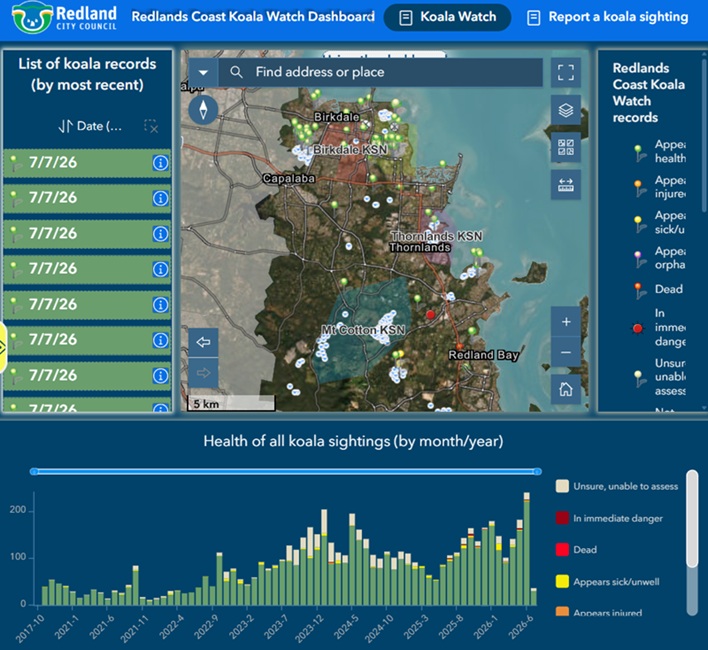
Residents are encouraged to report koala sightings through the online Redlands Coast Koala Watch platform. Information on Council’s koala protection initiatives is also available on Council’s website.