What’s happening?
Amanda Stoker MP has launched the Redlands Community Hoon Reporting Tool to address rising hooning across the community.
“Hooning is putting Redlands families at risk,” she said.
Illegal racing, burnouts, dangerous driving, excessive noise, near misses, and even marine hooning are being reported more often across Redlands.
Ms Stoker said she has been working closely with local police to support enforcement of hooning laws. Police have made it clear they need more reports and more precise information to act.
“That means they need people like us to collect and report the exact location, time, vehicle description, and registration details,” she said.
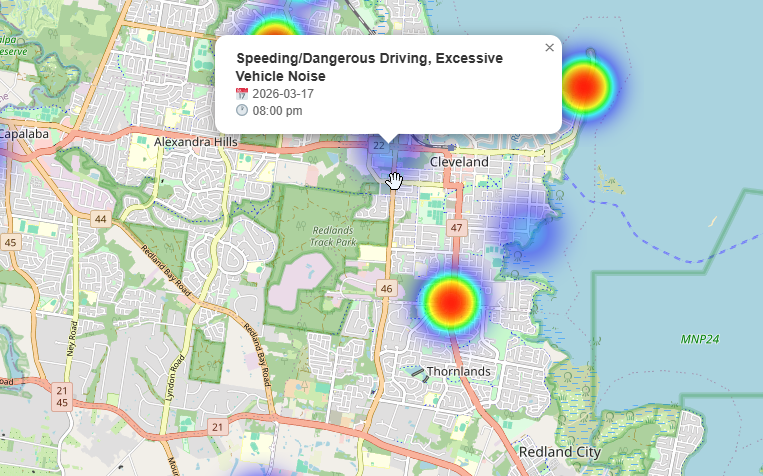
The reporting tool is designed to make this process simple and fast. Reports are sent directly to the police and Ms Stoker’s office. Approved incidents are also published on a public hotspot map to highlight problem areas and support stronger enforcement measures.
Why it matters
Hooning behaviour is creating safety risks across Redlands, affecting families, road users, and local communities.
Accurate and consistent reporting helps police understand when and where incidents occur. This supports more focused enforcement and improves the ability to respond to repeat behaviour.
The initiative also strengthens the connection between community reporting and police action.
Local impact
Residents in Cleveland and across Redlands are being encouraged to report incidents as they happen.
“Your reports are vital for enhancing police action and ensuring the safety of our community. Together, we can make our streets safer for everyone.”
Each report helps police build a clearer picture of hooning activity in the area. This can influence how resources are used and where enforcement is focused.
Community reporting is positioned as a key part of improving local safety outcomes.
By the numbers
-
Police assess each report based on severity, available evidence, and patterns, which helps determine how resources are prioritised.
-
Reports contribute to identifying trends and problem areas, helping police allocate patrols more effectively across Redlands.
-
Collected data supports the case for additional enforcement measures, including CCTV, targeted operations, and resource allocation.
Zoom in
When a report is submitted, it is sent to the Queensland Police Service for investigation and potential enforcement action.
It is also received by the Member for Oodgeroo’s office to monitor safety concerns, follow up on enforcement if needed, and support resource allocation.
Police responses are based on the severity of the incident, the quality of the information provided, and patterns identified in the area.
Not every report results in immediate action, but each one contributes to a broader understanding of hooning behaviour.
Zoom out
The reporting tool forms part of a wider approach involving multiple groups working together.
Residents report incidents they witness. Police investigate and take action where possible. Councils manage road conditions, speed limits, and traffic calming measures. The state government provides laws, funding, and technology.
Local representation also plays a role in advocating for resources and ongoing action.
What to look for next
As more reports are submitted, police will continue assessing incidents based on severity, available evidence, and patterns in the area.
The collected information will help identify problem locations and times, supporting more informed decisions on resource allocation.
It will also contribute to building the case for targeted operations, additional enforcement resources, and potential safety measures based on community reporting.